

Non-destructive testing is inspection techniques that evaluate the integrity and quality of materials and components without damaging them, preserving their capacity for future use. They are essential for identifying internal or surface flaws, such as cracks, corrosion or porosity, and are widely used in industries such as petrochemicals, aerospace and automobiles to ensure safety and reliability.
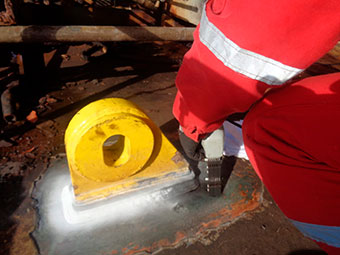
MAGNETIC PARTICULATE - PM
Magnetic particle testing Magnetic particle testing is widely used in industries to detect surface and subsurface discontinuities, up to approximately 3 mm in depth, in ferromagnetic materials.
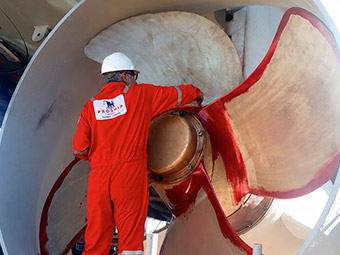
PENETRATING LIQUID - LP
Liquid penetrant is a chemical solution used in non-destructive testing to detect open discontinuities on the surfaces of materials such as metals, ceramics and plastics

EDDY CURRENT
Eddy current inspection is a non-destructive testing method that uses electromagnetic principles to detect flaws in conductive materials, such as surface and subsurface cracks.
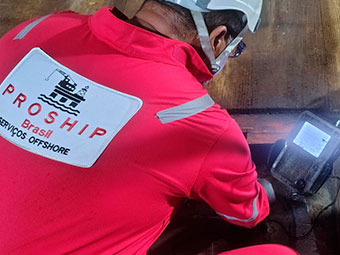
ULTRASONIC WELDING TEST
"Ulrasonic welding test" can refer to either an ultrasonic test to inspect welds or an ultrasonic welding process.
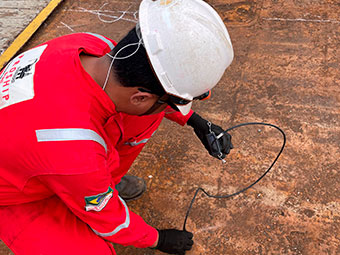
THICKNESS MEASUREMENT – ME
Thickness measurement testing is a non-destructive method for evaluating the thickness of materials, such as metals, plastics and ceramics, without damaging them.
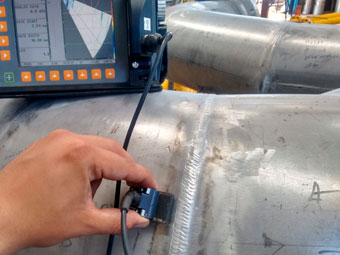
VISUAL INSPECTIONS
Visual inspections is a non-destructive inspection method that evaluates the quality and integrity of a welded joint, identifying surface defects such as cracks, porosity and discontinuities.
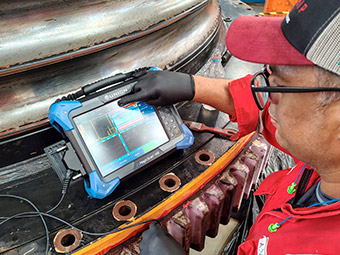
PHASED ARRAY – PA
A phased array test (or phased array ultrasound testing) is a non-destructive testing technique that uses multiple electronically controlled ultrasonic transducers (elements) to create and direct ultrasound beams with varying angles and adjustable focus.
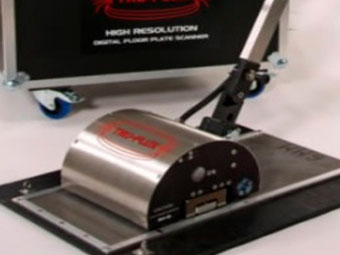
MFL ESSAY
MFL (Magnetic Flux Leakage) testing is a non-destructive testing method for inspecting ferromagnetic materials, such as storage tanks and piping.